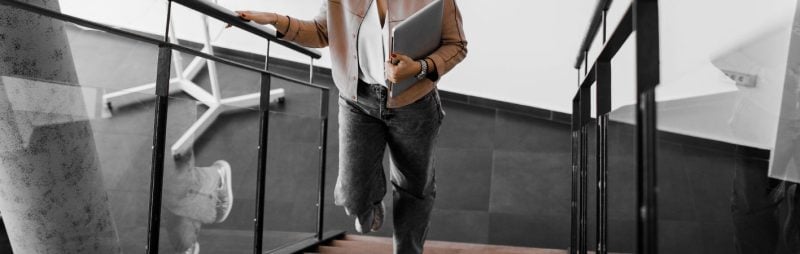
Take the stairs.
Although it’s one of the most repeated pieces of health and activity advice, it’s also one of the most underrated, perhaps because its benefits aren’t always immediately obvious. Nobody really believes sixty seconds of anything is going to make any difference whatsoever.
But, some recent research using UK accelerometer data suggests it just might, especially for people who do no formal exercise at all. We found the findings interesting, and thought you might too. They’ve been reported enthusiastically, but it’s the caveats that coaches really need to understand.
Where the Idea Came From
The term you’ll see in the research is VILPA, which stands for Vigorous Intermittent Lifestyle Physical Activity. In plain English it means the short bursts of hard effort that happen inside an ordinary day without anybody calling them exercise. Running for a bus. Carrying shopping up a hill. Taking the stairs two at a time because the lift is slow.
A group led from Sydney, working with researchers at Glasgow, UCL and Loughborough, investigated it using the UK Biobank dataset. Around 25,000 participants had worn a wrist accelerometer for a week, and all of them had reported doing no formal exercise whatsoever. The average age was 62.
What the devices picked up was interesting, even before looking at the health outcomes. Of all the vigorous activity recorded across the whole cohort, 92.3% of it came in bursts lasting a minute or less. Almost none of it looked anything like a workout.
Three Minutes and the Mortality Curve
Over an average of just under seven years, 852 of those participants died. When the researchers plotted the amount of VILPA against the risk of dying, the curve dropped fast and then flattened (Stamatakis et al., 2022).
At the cohort median, which was three short bursts a day or around four and a half minutes in total, all-cause mortality risk was 39% lower than at zero, with a hazard ratio of 0.61 and a confidence interval running from 0.50 to 0.74. For cardiovascular death specifically, the median dose sat at a hazard ratio of 0.51.
Those are large numbers for a very small dose, which is exactly why the study attracted so much attention. The comparison the authors made is particularly interesting: the dose-response curve for these accidental bursts looked almost identical to the curve for the 62,000 people in the same biobank who did structured exercise. Put simply, the body appears not to care much whether the effort was planned.
Two honest limits before we go further. UK Biobank had a response rate of 5.5% and is not representative of the UK population. And this is observational work, so people who take the stairs briskly at 62 may simply be healthier to begin with.
Another Finding
The same research group published a follow-up a year later that got a fraction of the coverage, but it does help us with the programming side.
They took the same cohort and split the activity by bout length rather than by total volume. Compared with bouts under one minute, bouts of one to three minutes carried a hazard ratio of 0.66 for mortality. Three to five minutes gave 0.56. Five to ten minutes gave 0.48 (Ahmadi et al., 2023).
In other words, longer bouts of activity were progressively better across the whole range. The sub-minute burst was where most of the activity happened, but had less effect.
Also, bouts under a minute were only associated with lower cardiovascular risk when at least 15% of the bout was properly vigorous. A leisurely minute on the stairs does nothing. The intensity is doing the work here, and the brevity is a concession to real life.
It Takes Longer to Work Hard Than You Think
The same group put 70 adults with an average age of 58 through nine ordinary daily-living activities in a lab and measured how long each one took to produce a properly vigorous physiological response. By percentage of maximal oxygen uptake, it took an average of 76.7 seconds. By percentage of maximum heart rate, 82.8 seconds. But by rating of perceived exertion, people reported hitting vigorous at 44.6 seconds (Ahmadi et al., 2024).
There was no difference by age or sex. So a client will feel that a bout is hard roughly thirty seconds before their physiology agrees, which means a twenty-second burst up a flight of stairs doesn’t really reach the intensity the epidemiology is describing, however unpleasant it felt.
If you take one programming rule from this article, take that one. Aim for a minute to a minute and a half or more of sustained hard effort, not just a twenty-second dash.
What the Training Studies Found
Epidemiology tells you what is associated with what. For cause and effect you need a trial, but the trials are smaller and more mixed.
The original stair-snacking study had sedentary young adults vigorously climb a three-flight stairwell, sixty steps, three times a day with one to four hours between each climb, three days a week for six weeks. Peak oxygen uptake rose in the climbing group against a non-training control at a p value of 0.003, though the authors were careful to describe the absolute increase as modest, at around 5%.
A larger 2024 trial ran it against a proper comparison. Forty-two inactive adults were randomised to exercise snacks, to forty minutes of steady cycling three times a week, or to a control group. The snack group climbed six flights three times a day, separated by at least an hour. Their peak oxygen uptake rose by 7%, a mean difference of 2.5 mL per kilogram per minute with a confidence interval of 1.2 to 3.7. The steady cycling group improved by 1.0, which did not reach significance. The control group declined by 1.7, which did.
Six flights, three times, three days a week is about five minutes of hard work spread across each training day. That produced more measurable change than two hours of steady cycling a week.
The Trial That Found Nothing
In this trial, seventy-seven inactive adults with an average age of 54 were randomised to either bodyweight exercise snacks or a stretching placebo, delivered remotely over twelve weeks. Three or more bouts a day of under a minute, three or more days a week, entirely unsupervised and at home. Adherence was excellent, with an average of 173 bouts completed, and people reported enjoying it.
There was no difference in peak oxygen uptake between the groups at all. The relative difference came out at 0.4 mL per kilogram per minute with a confidence interval running from minus 0.6 to 1.4. No difference in any blood marker of cardiometabolic health either (Babir et al., 2025).
The most likely explanation sits in the data. Average perceived exertion during the snack bouts was 3.0 out of 10. The protocol said vigorous. The participants delivered moderate. Left to choose their own intensity at home, people do not go hard, and without the intensity the whole thing stops working.
That single finding changes how our advice should go. Exercise snacks are not a hands-off prescription you can text to somebody.
Older Clients and the Chair Test
The picture changes when the target is muscle function rather than aerobic fitness, and the UK research is the most practical in the field.
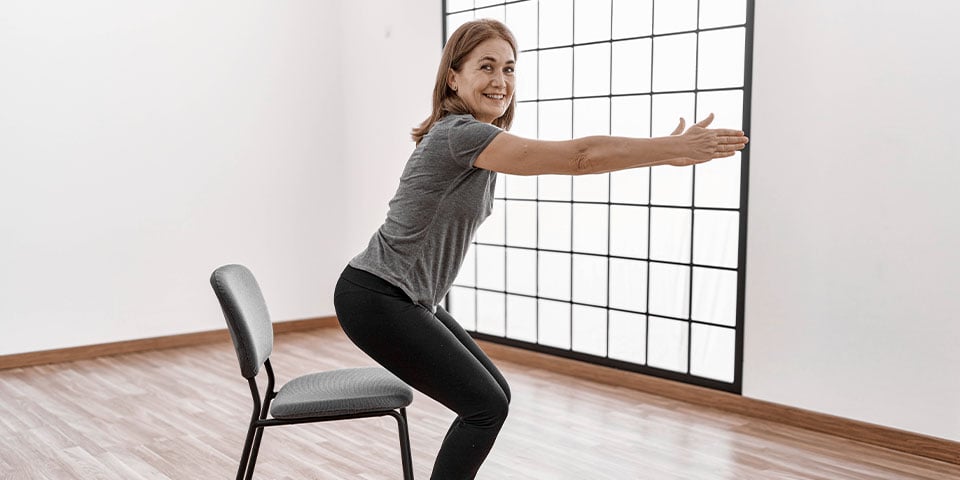
A pilot at the University of Bath gave twenty healthy adults aged 70 to 74 a set of bodyweight exercises to do twice a day, unsupervised, for 28 days. Sixty-second sit-to-stand performance improved by 31% in the exercise group with no change in the control group.
A follow-up ran the same idea with an older, more challenging population: 21 pre-frail older outpatients attending a memory clinic, all with low baseline physical function. They were given five muscle-strengthening exercises, maximum comfortable repetitions in one minute each, twice daily for 28 days. Adherence reached 85%, acceptability scored 4.6 out of 5, and the Short Physical Performance Battery, timed up-and-go and sit-to-stand all improved (Western et al., 2023).
This was a single-group study with no control, so some of that improvement will be people getting better at the test. The adherence figure is interesting, and for clients who find a gym intimidating and a full session exhausting, two short bouts a day at home is a starting point that most are happy to do.
Glucose, Sitting and the Working Day
For many clients, the first priority may not be adding workouts, but simply reducing long, uninterrupted periods of sitting. This is a different strategy to fitness training, with the benefits dependent on the demographic.
This crossover study put participants through nine hours of sitting, interrupted with fifteen to thirty seconds of stair climbing every hour. In healthy-weight men, nothing changed. In adults living with overweight or obesity, the insulin area under the curve fell by 16.5%. The intervention worked in the group whose glucose control needed the help.
A 2026 trial in people living with type 2 diabetes tested four one-minute vigorous bodyweight bouts performed on consecutive days, with glucose monitored continuously. The prespecified primary outcome related to mean glucose concentration. This however, did not reach statistical significance: mean glucose fell by 0.2 mmol/L, with a p value of 0.07.
Several secondary measures did move in the expected direction, including glycaemic variability and two-hour post-meal glucose after breakfast and dinner. The conclusion is that timing may be the key lever, in that short bouts performed after meals seem to improve glucose control more reliably than the same bouts done before meals.
What the Consensus Statement Says
In September 2025, 48 researchers from eleven countries published a consensus statement on short accumulated bouts of exercise, built from 27 systematic reviews and 135 original studies. Three of the authors are UK-based, at Bath, Stirling and Swansea.
Their working definition is broader than the one-minute snack and states that activity of any intensity accumulated in bouts of up to ten minutes, performed at least twice a day, with at least thirty minutes between bouts (Yin et al., 2025).
Two numbers are especially important from a practical standpoint: adherence and adverse events. Across the included studies, participants completed an average of 85% of prescribed unsupervised sessions, compared with 63% for unsupervised high-intensity interval training in a comparable meta-analysis. Adverse events were also very uncommon, occurring in 0.0% of completed sessions among young and middle-aged participants and 0.1% among older adults. Together, these findings suggest that the intervention may be feasible, tolerable and relatively safe outside supervised settings, although the comparison with HIIT is indirect and session-based adverse-event reporting may underestimate risk among participants who dropped out or avoided exercise because of symptoms.
The statement is also careful about what it doesn’t say. Almost all of that safety data comes from low and moderate intensity protocols. There is very little safety evidence for vigorous short bouts, which is precisely the point the mortality research leans towards. Basically, screen before you prescribe all-out stair efforts to a deconditioned client.
Adherence Is the Whole Problem
A UK team based at Loughborough and Birmingham has been testing a version of this called Snacktivity, which asks people to accumulate their weekly activity in two to five minute pieces. The feasibility trial recruited well, with 90% of its target, and retained people comfortably.
Adherence to the snacking itself was 32%, with a confidence interval from 17% to 48%. The researchers had set their own progression criteria in advance and rated that result red (Daley et al., 2025).
A full trial of 966 inactive adults recruited through the NHS is now running with a twelve-month primary outcome. That study will decide whether this works in a UK population. We’ll wait to see those results.
One in three sticking with it is a reasonable result for a feasibility study, and a reminder that short does not automatically mean easy to maintain. The coaching around the prescription is as important as the prescription itself.
Current UK Guidance
The UK Chief Medical Officers removed the ten-minute minimum bout length back in 2019, and the refreshed guidelines published in July 2026 restate it in simple terms. The weekly 150 minutes can be accumulated in bouts of any length while still retaining beneficial effects.
The 2026 refresh leans on the line that every movement counts, with a new emphasis on light activity, on breaking up prolonged sitting and on strength and balance across all life stages. What it does not do is endorse vigorous snacking specifically. Short bouts count towards the total, which is more just an indication rather than a complete protocol.
The scale of the opportunity is in Sport England’s Active Lives figures. Of adults in England, 24.7% do less than thirty minutes of activity a week. That is 11.8 million people, and for most, the barrier is not simply access to a gym. The challenge is helping people build activity into everyday life in ways that feel achievable, affordable and relevant to them.
Programming It
Here’s what the evidence supports and how it can be turned into something you can share with your clients.
| What the Client Wants | What the Evidence Supports | How to Programme It |
|---|---|---|
| Better cardiorespiratory fitness | Three hard bouts a day, at least an hour apart, three days a week | Thirty seconds up six flights, 48 hours between training days, progress by adding flights before adding bouts |
| Breaking up a desk day | Two to five minutes of movement every 30 to 60 minutes | An hourly prompt on the phone. Frequency is doing more here than intensity |
| Steadier glucose after meals | Short bouts placed after eating rather than before | Four one-minute bodyweight bouts spread across the hour after a main meal |
| Lower-body function in older clients | Bodyweight snacks twice a day, morning and evening | Five exercises, comfortable maximum reps in one minute each, sit-to-stand as the anchor |
| Something to do on a no-session week | Accumulated bouts maintain more than they build | Keep the weekly 150 minutes as the target and let the snacks fill the gaps |
In the table however, there is no row for strength or power, and that’s because the meta-analytic evidence for those outcomes did not show statistical relevance for small sample sizes. There’s also no row for weight loss, because the pooled effect on body mass is null.
Bringing It Into Your Coaching
When a client says, “I have no time,” treat it as information, not resistance. The goal is not to argue them into a schedule they’re probably not going to follow. It’s to get them active around what they feel they can’t give up.
Be direct and honest about what you’re recommending, though. Exercise snacks should be a supplement to structured training, not a replacement for it, and every research paper we’ve looked at says exactly that. For a client who trains twice a week and sits for nine hours a day, snacks fill the gaps between sessions. For a client who does nothing at all, they’re a great starting point.
Make the intensity a priority and it’s best to show them exactly what they need to do, in person at least once. The null trial failed because unsupervised adults chose moderate when the protocol said vigorous, so have them do it in front of you, showing them what a 7 out of 10 feels like and then check it at the next session. Aim for a minute rather than twenty seconds, because that is roughly how long it takes to get the required intensity.
Anchor the bouts to something they do already. After the morning coffee, after lunch, on the way back up to the office. A prompt that’s linked to an existing habit is more likely to stick than a single isolated call to exercise.
And set the expectation plainly, simply and honestly. It’s the best way to get a sedentary person moving and to keep them moving on the weeks when life gets in the way. The changes won’t be dramatic, but depending on someone’s starting point, they are going to be better than doing nothing at all.
References
Ahmadi, M.N., Hamer, M., Gill, J.M.R., Murphy, M., Sanders, J.P., Doherty, A. and Stamatakis, E. (2023). Brief bouts of device-measured intermittent lifestyle physical activity and its association with major adverse cardiovascular events and mortality in people who do not exercise: a prospective cohort study. The Lancet Public Health, 8(10), pp.e800-e810. Click here to review the full research article.
Ahmadi, M.N., Holtermann, A., Tudor-Locke, C., Koster, A., Johnson, N., Chau, J., Wei, L.E., Sabag, A., Maher, C., Thøgersen-Ntoumani, C. and Stamatakis, E. (2024). Time to Elicit Physiological and Exertional Vigorous Responses from Daily Living Activities: Setting Foundations of an Empirical Definition of VILPA. Medicine and Science in Sports and Exercise, 56(12), pp.2413-2420. Click here to review the full research article.
Babir, F.J., Islam, H., McCreary, S., Vaz, E., Falkenhain, K., Cranston, K., Jung, M., Singer, J., Sandilands, R., Marcotte-Chénard, A., Stamatakis, E., Richards, D.L., Gibala, M.J. and Little, J.P. (2025). Technology-Enabled Exercise ‘Snacks’ Are Feasible to Perform in a Real-World Setting: A Randomized Controlled Trial. Scandinavian Journal of Medicine and Science in Sports, 35(8), e70117. Click here to review the full research article.
Daley, A.J., Griffin, R.A., Sanders, J.P., Gokal, K., Ives, N., Skrybant, M., Parretti, H.M., Edwardson, C.L., Biddle, S.J.H., Jolly, K. and Moakes, C.A. (2025). Snacktivity to Promote Physical Activity in Primary Care, Community Health and Public Health Settings: A Feasibility Randomised Controlled Trial. International Journal of Behavioral Medicine, 32(5), pp.702-716. Click here to review the full research article.
Stamatakis, E., Ahmadi, M.N., Gill, J.M.R., Thøgersen-Ntoumani, C., Gibala, M.J., Doherty, A. and Hamer, M. (2022). Association of wearable device-measured vigorous intermittent lifestyle physical activity with mortality. Nature Medicine, 28(12), pp.2521-2529. Click here to review the full research article.
Western, M.J., Welsh, T., Keen, K., Bishop, V. and Perkin, O.J. (2023). Exercise snacking to improve physical function in pre-frail older adult memory clinic patients: a 28-day pilot study. BMC Geriatrics, 23(1), 471. Click here to review the full research article.
Yin, M., Li, Y., Aziz, A.R., Buffey, A., Bishop, D.J., Bao, D., Nassis, G.P., Islam, H., Wang, H., Fyfe, J.J., Chen, P. and Mao, L. (2025). Short bouts of accumulated exercise: Review and consensus statement on definition, efficacy, feasibility, practical applications, and future directions. Journal of Sport and Health Science, 15, 101088. Click here to review the full research article.
Train the Clients Who Never Have Time
The clients who need this approach most are usually the ones who are sent by their GP with a new diagnosis. A periodised exercise programme would help, but their commitment may be poor. What they do need is someone who can screen them properly and then build something that fits in with their life as it is now.
Our Level 3 Exercise Referral qualification covers screening, risk stratification and adapting exercise for the conditions that come through a GP referral. It’s the course that turns a sympathetic conversation into a plan you’re qualified to deliver.
Weekend Sale: Get started on the UK's leading Exercise Referral course and save £100 when you pay in full upfront. Use Promo Code EXREF20 at checkout. Priced from £399, or £83/month. Offer Ends 23rd October!
Level 3 Exercise Referral – Distance Study