Get an extra £200 off PT diplomas.

Get Started
TRAINFITNESS Personal Training Courses & Fitness Qualifications 0207 2929 140 WhatsApp
Log in

Programme 6

Thirty-Minute Fitness

Two 30-minute full-body sessions a week with dumbbells and a kettlebell to get fitter from the start.

Get the PDF and tracker
Goal
Fitness
Who it's for
Beginners short on time who want to get fitter with a pair of dumbbells and a kettlebell, at home or in the gym.
Level
Beginner
Length
6 weeks
Days per week
2
Session time
30 minutes
Equipment
Dumbbells, Kettlebell
Split
Full body
Publish week
2026-W36

Why It Works

Thirty-Minute Fitness is for beginners who want to get fitter but do not have much time. You train twice a week for 30 minutes with a pair of dumbbells, a kettlebell and a mat, so you can do it at home or in a gym.

Each session works the whole body, and the exercises come in pairs. You do the first exercise, go straight into the second, then rest. Working this way keeps your heart rate up, so you build strength and fitness in the same session, and a full workout fits into half an hour.

Day 1 is built around the kettlebell deadlift, which teaches you to lift from your hips with a flat back. Day 2 adds the kettlebell swing. The swing is the same hip movement done fast, and it is the hardest work in the programme. Get the deadlift right first and the swing is much easier to learn.

Every set has a rep range and an effort target. Stop each set with two or three good reps left. The sessions stay the same for all six weeks, so you can see your numbers go up. You do a short fitness test in week 1 and repeat it in week 6.

Get the PDF and Tracker

Both files are free. The PDF has every session, ready to print or keep on your phone. The Excel tracker logs your weights and reps each week and charts your progress.

Enter your email to get both files

We'll unlock them here and email you the links. Tick the box to get a new one every week.

How to Use It

Your week

  1. Mon Day 1 Deadlift, Push and Pull
  2. Tue
  3. Wed
  4. Thu Day 2 Squat, Swing and Press
  5. Fri
  6. Sat
  7. Sun

How Hard Should It Feel?

Every exercise has an effort target, such as "2 left in the tank (RIR 2)". RIR stands for Reps in Reserve: how many more good reps you could have done when you stop the set. Choose a weight that leaves you that many reps short.

0 Nothing left Another rep would fail or break your form.
1 One left You could do one more good rep, and no more.
2 Two left Hard work, with two good reps to spare.
3+ Three or more left You could do three or more reps, so push a little harder next set.

How to Progress

Each exercise has a rep range, such as 8–12. Use the same weight for every set and stay inside the range.

When you reach the top of the range on every set with good form, add the smallest weight step next time. Your reps will drop a little. Build them back up to the top of the range, then add weight again.

For bodyweight exercises, add reps until you reach the top of the range on every set, then switch to the harder option.

For this programme

Start with weights you could lift for two more reps at the top of the range. When every set reaches the top, add the smallest weight step. Kettlebells usually go up 4 kg at a time, which is a big jump, so stay with one bell and add reps until the swing feels easy for 15. For push-ups, start with your hands on a raised surface and lower it over the weeks until you reach the floor.

Before You Start

Read these questions and answer yes or no to each one before your first session.

  • Has a doctor ever said you have a heart condition, or told you to do physical activity only under medical supervision?
  • Do you get chest pain at rest, in daily life or when you are active?
  • Do you lose your balance because of dizziness, or have you lost consciousness in the last 12 months?
  • Have you been diagnosed with a long-term (chronic) medical condition?
  • Do you take prescribed medicine for a long-term medical condition?
  • Do you have a bone, joint or soft-tissue problem that could get worse if you become more active?
  • Are you pregnant, or have you given birth in the last six months?

If you answer yes to any of these, speak to your GP before starting.

Disclaimer

This programme is general information about exercise. It is not medical advice and does not replace advice from your GP or another health professional.

Stop and get advice if you have pain, feel dizzy or feel unwell during or after a session. Use weights you can control with good form, and ask a qualified trainer if you are not sure how to do an exercise.

You take part at your own risk.

Sessions

Day 1

Deadlift, Push and Pull

Warm-up

  • 3 minutes of marching on the spot or easy skipping, building to a steady pace
  • 10 bodyweight squats
  • 8 hip hinges with your hands on your hips
  • 5 slow push-ups against a wall or from your knees
  • 1 light set of 8 kettlebell deadlifts
Order Exercise Sets Reps Rest Effort Coaching cue
A1 Kettlebell deadlift: start and end positions Kettlebell deadlift 3 10–12 0s 2 left (RIR 2) Push your hips back with a flat back, then stand up by pushing the floor away.

Easier: Kettlebell deadlift with the bell on a low step

Harder: Kettlebell deadlift with a 3-second lowering

A2 Push-up: start and end positions Push-up 3 6–10 60s 2 left (RIR 2) Keep a straight line from head to heels and lower your chest to just above the floor.

Easier: Incline push-up

Harder: Push-up with a 3-second lowering

B1 Dumbbell in-place lunge: start and end positions Dumbbell in-place lunge 2 8–10 0s 2 left (RIR 2) Do all the reps on one leg, then the other. Each set is 8 to 10 on each leg.

Easier: In-place lunge without weights, holding a support

Harder: Dumbbell in-place lunge with a 3-second lowering

B2 Single-arm kettlebell row, split stance: start and end positions Single-arm kettlebell row, split stance 2 10–12 60s 2 left (RIR 2) Do all the reps on one arm, then the other. Swap your front foot when you swap arms.

Easier: Single-arm kettlebell row with a lighter bell

Harder: Single-arm kettlebell row with a 2-second hold at the top

C1 Kettlebell Russian twist: start and end positions Kettlebell Russian twist 2 12–16 0s 2 left (RIR 2) Count each turn to one side as one rep. Keep your heels on the floor and move slowly.

Easier: Russian twist without the kettlebell

Harder: Kettlebell Russian twist with your feet off the floor

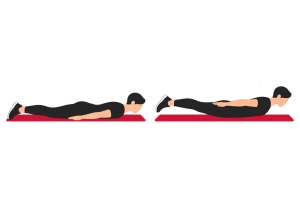
C2 Prone skydiver back extension: start and end positions Prone skydiver back extension 2 10–12 45s 3 left (RIR 3) Lift your chest and legs a little off the mat and squeeze your shoulder blades together.

Easier: Prone skydiver, arms and chest only

Harder: Prone skydiver with a 3-second hold at the top

Cool-down

  • 2 minutes of easy walking
  • Half-kneeling hip flexor stretch, about 30 seconds on both legs
  • Child's pose, about 30 seconds
Day 2

Squat, Swing and Press

Warm-up

  • 3 minutes of marching on the spot or easy skipping, building to a steady pace
  • 10 bodyweight squats
  • 10 arm circles forwards and 10 backwards
  • 8 kettlebell deadlifts, then 2 sets of 5 easy kettlebell swings
Order Exercise Sets Reps Rest Effort Coaching cue
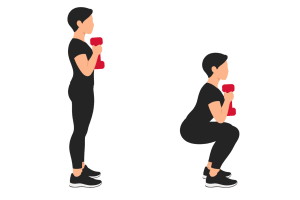
A1 Goblet squat: start and end positions Goblet squat 3 10–12 0s 2 left (RIR 2) Hold the dumbbell against your chest and sit down between your heels.

Easier: Goblet squat to a box

Harder: Goblet squat with a 3-second lowering

A2 Free-standing dumbbell prone fly: start and end positions Free-standing dumbbell prone fly 3 12–15 60s 2 left (RIR 2) Hinge forward with a flat back and raise the dumbbells out to the sides with soft elbows.

Easier: Free-standing prone fly without weights

Harder: Free-standing dumbbell prone fly with a 2-second hold

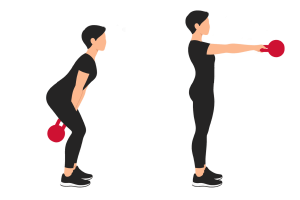
B1 Kettlebell swing: start and end positions Kettlebell swing 3 12–15 0s 3 left (RIR 3) Let your hips do the work and your arms just hold on. Stop the set if your back starts to round.

Easier: Kettlebell deadlift

Harder: Kettlebell swing with a heavier bell

B2 Split-stance dumbbell shoulder press: start and end positions Split-stance dumbbell shoulder press 3 8–10 60s 2 left (RIR 2) Swap your front foot on each set.

Easier: Split-stance dumbbell press, one arm at a time

Harder: Split-stance dumbbell shoulder press with a 3-second lowering

C1 Kneeling side bridge with leg raise: start and end positions Kneeling side bridge with leg raise 2 8–10 0s 3 left (RIR 3) Do all the reps on one side, then the other.

Easier: Kneeling side bridge

Harder: Full side bridge

C2 Prone plank up-down: start and end positions Prone plank up-down 2 6–8 45s 2 left (RIR 2) Count up to your hands and back down as one rep. Lead with the other arm each rep.

Easier: Prone plank up-down from the knees

Harder: Prone plank up-down with the feet together

Cool-down

  • 2 minutes of easy walking
  • Standing hamstring stretch, about 30 seconds on both legs
  • Chest stretch in a doorway, about 30 seconds

Week by Week

Read the note at the start of each week.

  1. Week 1

    Do the fitness test this week. Then find a starting weight for each exercise and write it down.

  2. Week 2

    Practise the kettlebell deadlift until your back stays flat on every rep. The swing on day 2 uses the same movement.

  3. Week 3

    Keep each pair moving. Go from the first exercise straight into the second, then take your rest.

  4. Week 4

    Add a rep or the smallest weight step to any exercise where every set reached the top of the range last week.

  5. Week 5

    Look at your tracker. If an exercise has not moved for two weeks, keep the weight and lower each rep to a slow count of three.

  6. Week 6

    Retest this week, in the same order and with the same rest as in week 1, then compare your results.

Test and Retest

Fitness Check

Do this test in week 1 and again in week 6, after your warm-up at the start of a session. Do the tests in the same order both times and rest 3 minutes between them.

TestUnitHow to do it
Push-ups reps Do as many push-ups as you can with good form. Use the same version both times, from the floor or with your hands on a raised surface. Stop when your hips sag.
Chair squats in 1 minute reps Stand in front of a chair and squat until you lightly touch the seat, then stand up. Count the squats you can do in 1 minute with good form.
Forearm plank seconds Hold a forearm plank with your body in a straight line from head to heels. Stop the clock when your hips sag or lift, and record the time.

Do the test in week 1 and again in week 6.

0
0
Your Cart
Your cart is emptyReturn to Shop
Apply Coupon
Products you might like