Black Friday: our lowest prices of the year, now until Monday 30 November. Ends in

Get Started
TRAINFITNESS Personal Training Courses & Fitness Qualifications 0207 2929 140 WhatsApp
Log in

Programme 8

Two-Day Health

Two gym sessions a week, each with 20 minutes of cardio and a full-body workout, to get stronger, steadier and fitter.

Get the PDF and tracker
Goal
General health
Who it's for
Adults new to the gym who want to feel fitter and stronger and keep their joints healthy with two sessions a week.
Level
Beginner
Length
8 weeks
Days per week
2
Session time
60 minutes
Equipment
Resistance machines, Dumbbells, Cable machine, Treadmill, Exercise bike
Split
Full body
Publish week
2026-W38

Why It Works

Two-Day Health is for adults who are new to the gym and want to look after their health. Two sessions a week are enough to build strength in every major muscle group, and they leave plenty of room in the week for walking, work and family.

Each session starts with 20 minutes of steady cardio: an incline walk on the treadmill on day 1 and the exercise bike on day 2. That works your heart and lungs and warms you up for the weights.

The rest of the session works the whole body. The machines guide the movement, so you can push hard on the legs, chest and back without worrying about balance. Dumbbells come in for the step-up, the shoulder press and the Romanian deadlift, which train the movements you use every day: climbing stairs, lifting things onto a shelf and picking things up from the floor.

Both days finish with balance and trunk work. Standing on one leg and holding a side bridge train the small muscles that keep you steady on your feet. That matters more with every year you get older.

Every set has a rep range and an effort target. Stop each set with two or three good reps left. The sessions stay the same for all eight weeks, so you can watch your numbers go up. You do a short health check in week 1 and repeat it in week 8.

Get the PDF and Tracker

Both files are free. The PDF has every session, ready to print or keep on your phone. The Excel tracker logs your weights and reps each week and charts your progress.

Enter your email to get both files

We'll unlock them here and email you the links. Tick the box to get a new one every week.

How to Use It

Your week

  1. Mon Day 1 Legs, Push and Pull
  2. Tue
  3. Wed
  4. Thu Day 2 Hinge, Press and Pull
  5. Fri
  6. Sat
  7. Sun

How Hard Should It Feel?

Every exercise has an effort target, such as "2 left in the tank (RIR 2)". RIR stands for Reps in Reserve: how many more good reps you could have done when you stop the set. Choose a weight that leaves you that many reps short.

0 Nothing left Another rep would fail or break your form.
1 One left You could do one more good rep, and no more.
2 Two left Hard work, with two good reps to spare.
3+ Three or more left You could do three or more reps, so push a little harder next set.

How to Progress

Each exercise has a rep range, such as 8–12. Use the same weight for every set and stay inside the range.

When you reach the top of the range on every set with good form, add the smallest weight step next time. Your reps will drop a little. Build them back up to the top of the range, then add weight again.

For bodyweight exercises, add reps until you reach the top of the range on every set, then switch to the harder option.

For this programme

Start each exercise with a weight you could lift for two more reps at the top of the range. On the machines, move the pin down one plate when every set reaches the top of the range. Dumbbells usually go up 1 to 2 kg at a time. If that jump is too big, keep the weight and add a rep to each set first. For the balance and trunk work, add a rep or hold each rep a little longer before you go harder.

Before You Start

Read these questions and answer yes or no to each one before your first session.

  • Has a doctor ever said you have a heart condition, or told you to do physical activity only under medical supervision?
  • Do you get chest pain at rest, in daily life or when you are active?
  • Do you lose your balance because of dizziness, or have you lost consciousness in the last 12 months?
  • Have you been diagnosed with a long-term (chronic) medical condition?
  • Do you take prescribed medicine for a long-term medical condition?
  • Do you have a bone, joint or soft-tissue problem that could get worse if you become more active?
  • Are you pregnant, or have you given birth in the last six months?

If you answer yes to any of these, speak to your GP before starting.

Disclaimer

This programme is general information about exercise. It is not medical advice and does not replace advice from your GP or another health professional.

Stop and get advice if you have pain, feel dizzy or feel unwell during or after a session. Use weights you can control with good form, and ask a qualified trainer if you are not sure how to do an exercise.

You take part at your own risk.

Sessions

Day 1

Legs, Push and Pull

Warm-up

  • 20 minutes of incline walking on the treadmill, at a pace where you can still talk in short sentences
  • 10 bodyweight squats to a bench
  • 10 arm circles forwards and 10 backwards
  • 1 light set of 10 on the leg press, then 1 light set of 10 on the chest press
Order Exercise Sets Reps Rest Effort Coaching cue
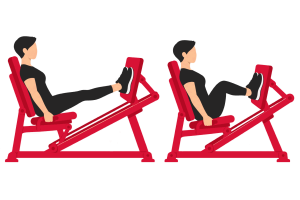
A Leg press: start and end positions Leg press 3 10–12 90s 2 left (RIR 2) Lower until your knees reach about 90 degrees, then press through your whole foot.

Easier: Leg press with a shorter range

Harder: Leg press with a pause at the bottom

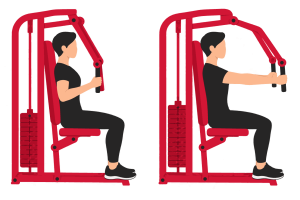
B Machine chest press: start and end positions Machine chest press 3 10–12 90s 2 left (RIR 2) Set the seat so the handles line up with the middle of your chest.

Easier: Incline push-up

Harder: Machine chest press with a pause at the chest

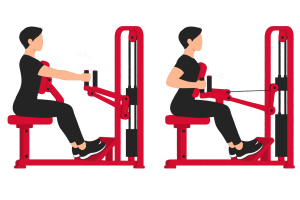
C Machine seated row: start and end positions Machine seated row 3 10–12 90s 2 left (RIR 2) Keep your chest on the pad and pull your elbows back until your hands reach your ribs.

Easier: Machine seated row, one arm at a time

Harder: Machine seated row with a 2-second squeeze

D1 Dumbbell goblet step-up: start and end positions Dumbbell goblet step-up 2 8–10 0s 2 left (RIR 2) Do all the reps on one leg, then the other. Each set is 8 to 10 on each leg.

Easier: Goblet step-up to a lower box

Harder: Goblet step-up with a 3-second lowering

D2 Seated dumbbell lateral raise: start and end positions Seated dumbbell lateral raise 2 10–12 60s 2 left (RIR 2) Sit tall and lift the dumbbells out to the sides until your arms are level with your shoulders.

Easier: Seated lateral raise, one arm at a time

Harder: Seated lateral raise with a 2-second pause at the top

E1 Single-leg balance with excursion: start and end positions Single-leg balance with excursion 2 4–6 0s 3 left (RIR 3) Reach forward, out to the side and behind, and count that as one rep. Do all the reps on one leg, then the other.

Easier: Single-leg balance with a hand on a wall

Harder: Single-leg balance with excursion, reaching further

E2 McGill abdominal crunch: start and end positions McGill abdominal crunch 2 5–8 45s 3 left (RIR 3) Hold each rep for a slow count of five. Swap the bent leg halfway through the set.

Easier: McGill crunch with a shorter hold

Harder: McGill crunch with the elbows lifted off the mat

Cool-down

  • 3 minutes of easy walking
  • Standing quad stretch, about 30 seconds on both legs
  • Chest stretch in a doorway, about 30 seconds
Day 2

Hinge, Press and Pull

Warm-up

  • 20 minutes on the exercise bike, at a pace where you can still talk in short sentences
  • 10 glute bridges
  • 8 hip hinges with your hands on your hips
  • 1 light set of 8 Romanian deadlifts with light dumbbells
Order Exercise Sets Reps Rest Effort Coaching cue
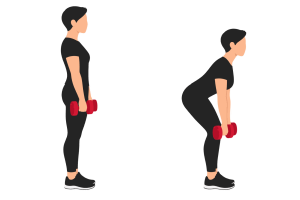
A Dumbbell Romanian deadlift: start and end positions Dumbbell Romanian deadlift 3 8–12 2 min 2 left (RIR 2) Push your hips back and keep the dumbbells close to your legs.

Easier: Romanian deadlift to mid-shin

Harder: Single-leg Romanian deadlift

B Unsupported seated dumbbell press: start and end positions Unsupported seated dumbbell press 3 8–12 90s 2 left (RIR 2) Sit tall on the bench with no back support and press the dumbbells up without leaning back.

Easier: Seated dumbbell shoulder press with back support

Harder: Unsupported seated press, one arm at a time

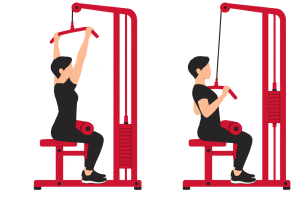
C Lat pulldown: start and end positions Lat pulldown 3 10–12 90s 2 left (RIR 2) Pull the bar to your upper chest and lead with your elbows.

Easier: Lat pulldown with a neutral grip

Harder: Lat pulldown with a 3-second lowering

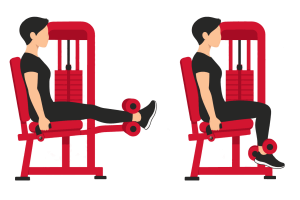
D1 Seated leg curl: start and end positions Seated leg curl 2 10–12 0s 2 left (RIR 2) Line your knees up with the machine's pivot and pull your heels under the seat.

Easier: Seated leg curl with a shorter range

Harder: Seated leg curl with a 3-second lowering

D2 Shoulders-elevated hip bridge: start and end positions Shoulders-elevated hip bridge 2 10–15 60s 2 left (RIR 2) Rest your upper back on the bench and push through your heels until your body is flat from shoulders to knees.

Easier: Glute bridge on the floor

Harder: Shoulders-elevated hip bridge with a dumbbell across your hips

E Kneeling side bridge: start and end positions Kneeling side bridge 2 5–8 45s 3 left (RIR 3) Hold each rep for 5 seconds, then lower your hips to the mat. Do all the reps on one side, then the other.

Easier: Kneeling side bridge with a shorter hold

Harder: Full side bridge

Cool-down

  • 3 minutes of easy walking
  • Standing hamstring stretch, about 30 seconds on both legs
  • Child's pose, about 30 seconds

Week by Week

Read the note at the start of each week.

  1. Week 1

    Do the health check this week. Then find a starting weight for each exercise and write it down, including the seat and pin settings on each machine.

  2. Week 2

    Lower every rep to a slow count of two. It keeps the weight under control and makes each rep count.

  3. Week 3

    Check your effort. Two reps left should feel hard, but your last rep should look the same as your first.

  4. Week 4

    Add weight to any exercise where every set reached the top of the rep range last week. Use the smallest step the gym has.

  5. Week 5

    Keep moving on the days in between. A 20-minute walk on your rest days helps you recover from the sessions.

  6. Week 6

    Look at your tracker. If an exercise has not moved for two weeks, keep the weight and aim for one more rep on each set.

  7. Week 7

    Try the balance work without looking down. Fix your eyes on a point on the wall in front of you.

  8. Week 8

    Repeat the health check this week, in the same order as in week 1, then compare your results.

Test and Retest

Health Check

Do this check in week 1 and again in week 8, after your warm-up at the start of a session. Do the tests in the same order both times and rest 2 minutes between them.

TestUnitHow to do it
Chair stands in 1 minute reps Sit on a chair with your arms crossed over your chest. Stand up fully, then sit back down. Count how many you can do in 1 minute with good form.
Single-leg balance seconds Stand on one leg with your hands on your hips and time how long you can hold it, up to 60 seconds. Test both legs and record the shorter time.
Machine chest press, 10 reps kg Build up over a few sets to the heaviest weight you can press for 10 good reps, with about one rep left in the tank. Record that weight.

Do the test in week 1 and again in week 8.

0
0
Your Cart
Your cart is emptyReturn to Shop
Products you might like