Many of us have a client who has started moving differently. They take the stairs one at a time now. They reach for the back of a chair before they sit down. Somewhere in the warm-up chat they mention a bit of a stumble in the kitchen last month, and add that it was nothing really. It is easy to see that as simple ageing and carry on with the session you had planned.
There is a good reason not to. In April 2025 NICE published a new guideline on falls, replacing guidance that had stood since 2013. The committee wrote that falls prevention exercise programmes can be effectively delivered by qualified fitness instructors and do not need to be prescribed through NHS settings in all cases.
That is a large and underserved client group, and most trainers already have some of them on the books. What the guideline does not do is tell you what to deliver.
A Guideline
NG249 is called Falls: assessment and prevention in older people and in people 50 and over at higher risk. It was published on 29 April 2025 and it replaced CG161, which had been the reference point since 2013. Alongside it, NICE updated its falls quality standard so that strength and balance training now has a quality statement of its own.
Around a third of people aged 65 and over, and around half of people aged 80 and over, fall at least once a year (Office for Health Improvement and Disparities, 2022). NICE puts emergency hospital admissions related to falls in England at roughly 210,000 a year among the over-65s, and gives a one-year mortality rate of 31% after a hip fracture. Fragility fractures cost the UK an estimated £4.4 billion a year, of which hip fractures alone account for about £2 billion.
Those numbers usually get used to argue for more NHS capacity. Set next to that line about qualified fitness instructors, they describe a lot of work the NHS is not going to be able to absorb.
What Changed in April 2025
Three things changed.
The first is the age line. The old guidance was about older people. This one covers everyone aged 65 and over plus anyone aged 50 to 64 who is at higher risk, which NICE illustrates with conditions such as Parkinson’s disease and diabetes rather than a numerical definition. That single change drags falls prevention out of geriatrics and into the age bracket where commercial gyms already have plenty of members.
The second is the triage. NICE sets out a clear ladder. Someone who has fallen in the past year and is living with frailty, was injured badly enough to need medical treatment, lost consciousness, could not get up on their own, or has fallen twice or more, needs a comprehensive falls assessment. Someone who has fallen without any of those features needs their gait and balance assessed. If a gait or balance impairment is found, NICE says to offer a falls prevention exercise programme, and offer is the strong word in NICE language. Everyone is directed to the Chief Medical Officers’ physical activity guidelines.
Recommendation 1.1.1 says do not use falls risk prediction tools to predict a person’s risk of falling. If you have been running a client through a scored questionnaire and giving them a percentage, stop.
What NG249 Says About Exercise
NICE asks that falls prevention exercise programmes be delivered by appropriately trained professionals, be progressive and tailored to the person’s needs, preferences, goals and abilities, focus on functional components related to their risk of falls such as balance, coordination, strength and power, include regular progress reviews, and be delivered in a way that brings about lasting behaviour change.
There are no numbers in it. No hours per week. No sessions per week. No programme length. No total volume. No intensity. Balance, coordination, strength and power, progressive and tailored, and that is the whole prescription.
The falls research community has said the same thing. Writing in Age and Ageing, the British Geriatrics Society’s journal, a group of researchers noted that the exercise recommendations lack specificity regarding dosage and intensity parameters (Vandervelde et al., 2025). So if you have read NG249 and come away unsure what to programme, that is the guideline’s gap rather than yours.
The Programming Variables NICE Left Out
The variables question however, was answered years ago, in the same body of research NICE drew on.
The most useful number comes from a meta-analysis of 88 trials and more than 19,000 people published in the British Journal of Sports Medicine. Exercise overall cut the rate of falls by 21%. Programmes that challenged balance and involved more than three hours a week cut it by 39%, and those two variables between them explained three quarters of the difference between trials (Sherrington et al., 2017).
Three hours a week. Not two forty-five minute sessions, which is ninety minutes and lands well short. The Australian position statement written specifically for exercise professionals puts the same figure at three or more hours a week and reports reductions of over 40% (Tiedemann et al., 2025). Age UK’s own good practice guide for community providers gives two to three sessions a week or three hours a week, with six months as a minimum and ongoing exercise after that.
Total volume is the same. The older meta-analysis behind the frequently quoted fifty-hour figure found that programmes delivering more than about fifty hours across their whole length produced bigger effects. Treat that as a suggestion rather than a definite. A forty-nine hour programme does not fail; a twelve-week block at ninety minutes a week is not the same thing.
The benefit drops when the training stops. Both the Australian position statement and NICE’s own committee say the same thing in slightly different words: exercise has to become part of everyday life for the effect to hold. Falls prevention is a retention business rather than a block-booking business.
What Works, and What Does Not
Across 108 trials and more than 23,000 community-dwelling people, exercise reduced the rate of falls by 23% and the number of people falling by 15%, both graded high certainty (Sherrington et al., 2019).
The breakdown by exercise type is what’s interesting. Balance and functional exercise cut the rate of falls by 24% on high-certainty evidence from 39 trials. Programmes combining balance and functional work with resistance training did better still at 34%. Tai Chi came in at 19% on low-certainty evidence. Resistance training on its own, dance on its own and walking programmes on their own all landed in the same category: the reviewers were uncertain of the effects. No trial had even compared flexibility or endurance work against a control.
Two of these may go against what some trainers do by default.
Resistance training alone does not prevent falls. The Australian position statement states: strength training performed on its own is not effective in preventing falls. That may feel unusual, because leg strength is where most trainers start with an older client. Strength work is valuable however, as a partner to balance training, not as a replacement for it.
Walking is worse than neutral for this particular outcome. The Cochrane reviewers were uncertain about walking programmes. The earlier meta-analysis found the largest effects in programmes that did not include a walking component at all. And a UK randomised trial of brisk walking in postmenopausal women recorded a higher cumulative risk of falls in the walking group. Walking is superb for a dozen other things. Telling a wobbly client to get their steps up is not falls prevention, and for someone already at risk it may make things worse.

Four Checks You Can Run on Monday
None of what follows predicts whether a particular person will fall, and NG249 is explicit that you should not use anything for that purpose. Use these to work out where to pitch the programme, to trigger a conversation about seeing a GP, and to show progress at twelve weeks. The cut-offs come from the US Centers for Disease Control’s STEADI toolkit and from the European sarcopenia consensus, because no equivalent set has been published in the UK.
| Check | What Counts as a Concern | What You Do About It |
|---|---|---|
| Three questions. Have you fallen in the past year? Do you feel unsteady standing or walking? Do you worry about falling? | Any single yes | Ask about the falls properly. If they were injured, blacked out, could not get up alone, have fallen twice or more, or are living with frailty, they meet NICE’s criteria for a full falls assessment. Tell them to see their GP or self-refer to the local falls service, write down that you did, and keep training them meanwhile. |
| Timed Up and Go. Rise from a standard chair, walk three metres, turn, walk back, sit. | 12 seconds or more | Treat this as a gait and balance impairment. Under NG249 that is the group you offer a falls prevention programme to, not consider it for. Start progressive standing balance work now and retest at twelve weeks. |
| 30-second chair stand. Arms crossed on the chest, count full stands in 30 seconds. | Below the age and sex norm, for example under 12 for men or 11 for women at 65 to 69, and under 10 for men or 9 for women at 80 to 84 | Lower-limb strength is the limiter. Load sit-to-stand, step-ups, heel raises and wall squats. If they cannot rise without pushing off, score zero and start from a raised seat. |
| Four-stage balance. Feet together, then semi-tandem, then tandem, then single leg, ten seconds each. Stop at the first one they cannot hold. | Cannot hold tandem stance for ten seconds | This hands you the starting point. Train at the stage they failed, with hand support, and progress by taking the hands away before you narrow the feet further. |
| Five-times sit-to-stand, if you want a strength number rather than a rep count. | More than 15 seconds for five rises | Programme as for the chair stand. Paired with unexplained weight loss or a slow walking speed it is also a fair reason to mention sarcopenia when you suggest they see their GP. |
High-Challenge Balance
The research that produced those numbers defines a challenge to balance through three mechanisms, and all three happen in standing rather than seated.
The first is narrowing the base of support. Feet apart, then feet together, then semi-tandem with the instep against the big toe, then tandem heel to toe, then single leg. Progress each position by adding head turns and then overhead arm movements. Eyes closed only with a rail inside arm’s reach.

The second is moving the centre of mass under control. Graded reaching in standing, forward and sideways and across the body and down toward the floor.

Weight transfers. Stepping in four directions and returning to centre.
Tandem walking along a line, sideways walking, grapevine, walking backwards.
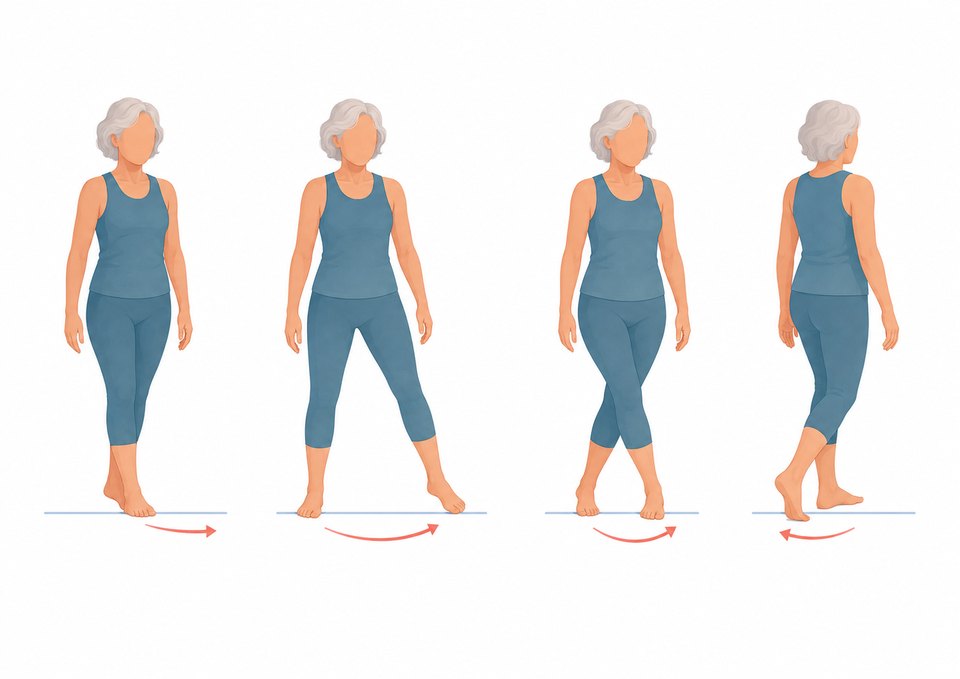
Turns of 180 and 360 degrees in both directions.
Step-ups onto a block and stepping over an obstacle.

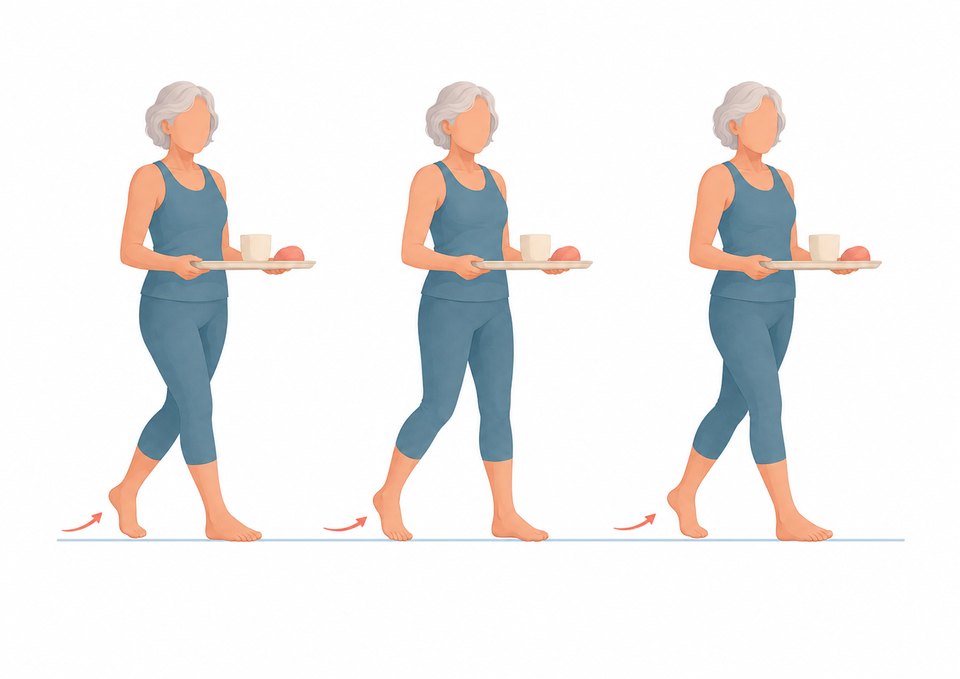
Once that is solid, dual tasking: walking while counting backwards in threes, or carrying a tray.
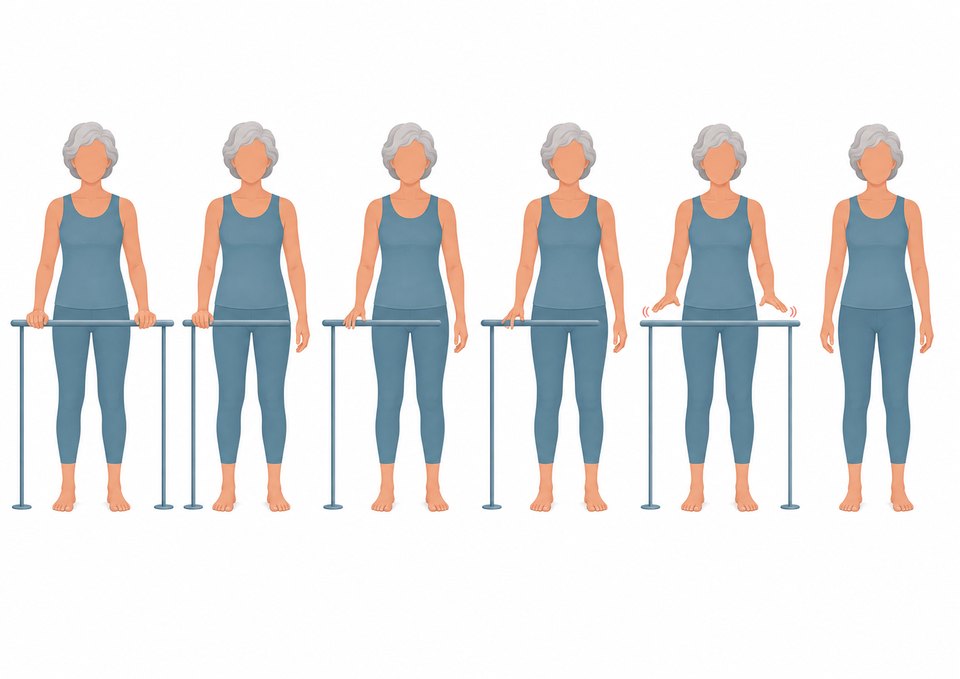
The third is reducing upper limb support, and this is a training variable in its own right, not just about safety. Two hands on the rail, then one hand, then two fingertips, then one fingertip, then hands hovering, then free standing with the rail still within reach.
Pair all that with functional lower-limb strength. Sit-to-stand without hands, then from a lower seat, then slower. Heel raises moving from two legs to one. Wall squats. Step-ups and stairs. Standing hip abduction and knee work, loaded with ankle cuff weights as they progress.
Then teach people how to get up off the floor. Most programmes leave it out. NG249 asks that everyone be told what to do if they fall, including how to get up and when to seek help. A client who can get themselves up has had an incident. A client who cannot has had a long lie, which is what turns a fall into a hospital admission.
Progressing Without Putting Your Client on the Floor
Change one variable at a time. Base of support, hand support, vision, static hold through to walking and turning, predictable through to reactive, single task through to dual task, and total weekly volume. Move one, hold the rest, and you will always know what caused the change.
When you need to regress, reverse one variable, and make it hand support first. Giving a fingertip back preserves the balance stimulus. Widening the stance removes it.
Every balance exercise gets set up within arm’s reach of something solid, and you never train balance to the point of an unplanned fall. That rule comes straight from the source research. Cochrane’s adverse event data across 27 trials is reassuring, mostly minor musculoskeletal complaints, but that was under supervision. Do not send high-challenge work home until you have watched the client do it properly in front of you.
In terms of equipment, wobble cushions, foam pads and half-balls are easily available in online stores, but there is no falls-outcome trial evidence behind them in older adults. The thing that has been tested is controlling the body over a narrowing base on a stable floor. That does not make this type of equipment useless, but it does mean it should replace what the evidence has said.
When to Stop Training and Start Signposting
Unexplained falls, blackouts or near-blackouts need medical investigation, and NG249 points specifically at cardiac causes. Rotational vertigo needs a clinical assessment. Dizziness on standing needs a lying and standing blood pressure check, which is not your job. Chest pain, palpitations or breathlessness out of proportion to the effort is urgent. New or progressing neurological signs, new confusion, low mood or a sudden change in gait all belong with a GP.
Polypharmacy sits in the same category, and psychotropic medicines particularly so. NG249 asks for a structured medication review and, where appropriate, planned withdrawal. Flag that a client is on a long list of tablets. Never advise on any of them.
Known osteoporosis or any previous fragility fracture is not a reason to stop training, but it is a reason to check they have been assessed for bone protection. The 2025 National Hip Fracture Database report found that 58% of hip fracture patients received bone-strengthening medication, which leaves a lot of people who did not.
Where You Stop and the NHS Starts
NG249’s comprehensive falls assessment has sixteen elements. Alcohol, cardiovascular examination with lying and standing blood pressure, cognition and mood, delirium, diet and fluid intake, dizziness, footwear, functional ability, gait and balance and muscle strength, hearing, long-term conditions, medication review, neurological examination, osteoporosis risk, continence, vision.
Only one of those is inside a personal trainer’s competence, and it happens to be the one that determines the programme: gait, balance, mobility and muscle strength. Simply put, you assess movement. Somebody qualified assesses everything else.
In December 2025 the National Audit Office reported that 18% of patients diagnosed with severe frailty in 2024-25 received a falls risk assessment, against a requirement of 100%, and that around 70% of local areas recorded fewer falls assessments than falls. The NIHR’s own review of community falls prevention in England describes provision as inconsistent and fragmented, with a shortage of appropriately trained staff.
So the system has told fitness professionals they are allowed to do this work, in print, while delivering the assessment step to fewer than one in five of the people entitled to it. Many of us find our clients sitting in this gap.
If you want to go further than general practice allows, the two named UK programmes have their own routes. The Otago Exercise Programme requires an Otago Exercise Programme Leader qualification, and FaME requires a Postural Stability Instructor qualification, both through Later Life Training. You can apply the principles tomorrow. You cannot call your class FaME. Check current entry requirements with Later Life Training directly, since they change.
Bringing It Into Your Coaching
You do not need a new qualification to start doing this better today. You need to ask three questions, watch someone stand up from a chair, and then put balance work in standing at the centre of the programme instead of at the end as a two-minute afterthought.
The evidence says balance and functional training is the active ingredient, strength work makes it better, walking does not do the job, three hours a week is the target, and it has to keep going. Most programmes fail because they under-dose, not because they choose the wrong exercises. A large UK trial delivered around half the recommended dose, mostly unsupervised, and found essentially nothing. Under-dosing does not produce a smaller effect. It can produce no effect at all.
Get it right and you have a client who still gets down on the floor to play with a grandchild at 78, and who gets back up again on their own.
References
National Institute for Health and Care Excellence (2025). Falls: Assessment and Prevention in Older People and in People 50 and Over at Higher Risk. NICE Guideline NG249. Click here to review the full research article.
Office for Health Improvement and Disparities (2022). Falls: Applying All Our Health. GOV.UK. Click here to review the full research article.
Sherrington, C., Michaleff, Z.A., Fairhall, N., Paul, S.S., Tiedemann, A., Whitney, J., Cumming, R.G., Herbert, R.D., Close, J.C.T. and Lord, S.R. (2017). Exercise to Prevent Falls in Older Adults: An Updated Systematic Review and Meta-Analysis. British Journal of Sports Medicine, 51(24), pp.1750-1758. Click here to review the full research article.
Sherrington, C., Fairhall, N.J., Wallbank, G.K., Tiedemann, A., Michaleff, Z.A., Howard, K., Clemson, L., Hopewell, S. and Lamb, S.E. (2019). Exercise for Preventing Falls in Older People Living in the Community. Cochrane Database of Systematic Reviews, 1, CD012424. Click here to review the full research article.
Tiedemann, A., Sturnieks, D.L., Burton, E., Thom, J.M., Lord, S.R., Scott, S. and Sherrington, C. (2025). Exercise and Sports Science Australia Updated Position Statement on Exercise for Preventing Falls in Older People Living in the Community. Journal of Science and Medicine in Sport, 28(2), pp.87-94. Click here to review the full research article.
Vandervelde, S., Skelton, D.A., Milisen, K., Treml, J. and Martin, F.C. (2025). Commentary on NICE Guidance 249, Falls: Assessment and Prevention in Older People and in People 50 and Over at Higher Risk. Age and Ageing, 54(11), afaf322. Click here to review the full research article.
Keep Your Clients on Their Feet
If you have clients who have started moving carefully, the next step is knowing how to train older and higher-risk bodies. Screening, progression, red flags and the confidence to know when to pick up the phone to a GP instead of doing another set.
Our Exercise for Older Adults Course covers exactly that, from the physiology of ageing through to programming for clients whose independence is the actual goal. It is distance study, so it fits around a full client diary.
Incredible Offer: Get started on the UK's leading Exercise for Older Adults course and save £50 when you pay in full upfront. Use code EOA10 at checkout. From just £349 or £67/month. Offer Ends 21st August!
Exercise for Older Adults – Distance Study