Not All Sets Are Created Equal
Walk into any gym where the regulars take their training seriously and you will hear the same conversation playing out somewhere between the squat rack and the cable station. “How many sets should I be doing?” followed closely by “Should I train chest twice a week or three times?” These are questions that personal trainers and S&C coaches field constantly and the honest answer has always been a bit muddy. The research pointed in a general direction, more volume tends to be good, training more often helps, but the finer details have been quite difficult to truly identify.
You maybe happy to know that we are getting closer to a more definitive answer. In February 2026, a team from Florida Atlantic University’s Muscle Physiology Laboratory published what is arguably the most comprehensive analysis of resistance training dose-response data to date. Pelland and colleagues pulled together 67 studies involving 2,058 participants and ran a series of multi-level meta-regressions to explore how weekly set volume and training frequency actually relate to gains in muscle size and strength (Pelland et al., 2026). The results offer a fresh perspective on programme design and challenges a few assumptions that many of us have based our programming on for years.
What makes this study stand out from previous meta-analyses is not just the scale of it, but the researchers introduced a new method of quantifying training volume that accounts for something most previous studies have ignored. And that’s the difference between direct and indirect sets.
The Problem With How We Have Been Counting Sets
Here is a scenario you’ll probably recognise. A client is doing four sets of bench press and three sets of tricep pushdowns in the same session. That is seven sets total, but how many of those count as tricep volume? The bench press directly targets the chest, but the triceps are working hard during every rep as well. So does a bench press set count as a tricep set?
Previous research handled this question in one of two ways. The “total” method counted every set that involved a muscle group, regardless of how directly it was targeted. Under this system, those four bench press sets would count as four full tricep sets, bringing the total to seven. The “direct” method went the other direction and only counted sets where the muscle was the primary target. The bench press sets would count as zero for the triceps, leaving just the three pushdown sets.
Pelland et al. (2026) tested a third option they called the “fractional” method. Under this approach, indirect sets count at half value. So those four bench press sets become two tricep sets (four multiplied by 0.5), giving a fractional total of five sets for the triceps. When they ran their meta-regressions using all three methods, the fractional approach produced the strongest evidence and the best-fitting models for predicting both hypertrophy and strength outcomes.
On paper, this looks like a simple detail within the research. In practice however, it has the ability to reshape how we design programmes. For example, when auditing a client’s training programme and tallying up weekly volume per muscle group, the way we calculate volume will change dramatically. A push/pull/legs split might look like it delivers 12 direct sets for the biceps per week, but when you add in the fractional contribution from rows, pull-ups and other pulling movements, the true effective volume could be significantly higher. The knock-on effect is that it will change the decisions we make about the number of isolation sets to add and how we can reallocate some of that limited time clients have for training. For personal trainer course students, getting comfortable with this kind of volume accounting is a practical skill that separates thoughtful programming from guesswork.
The Dose-Response Matrix[
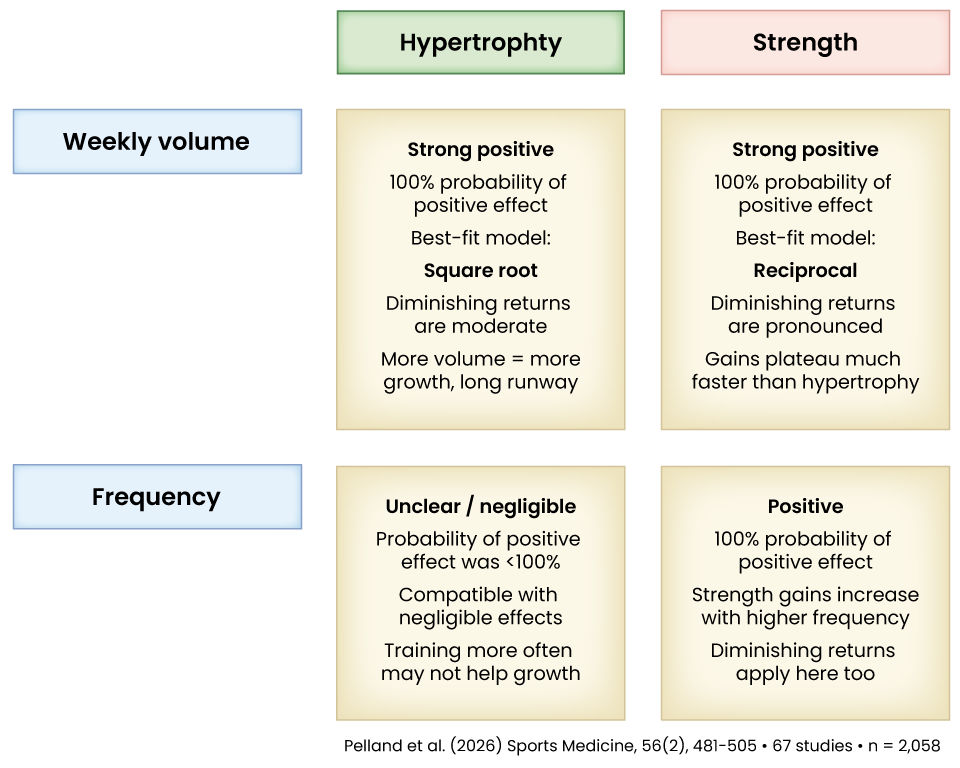
The Pelland et al. (2026) study looked at two programming variables that we all manipulate on a daily basis: weekly set volume (how many sets you perform for a muscle group each week) and training frequency (how many sessions per week that muscle group gets trained). They then measured how each of those variables related to two separate outcomes: muscle hypertrophy and muscular strength. We’ve laid the results out in the matrix below. What stands out immediately is that these variables don’t behave the same way for each goal. Volume and frequency each have a distinct relationship with growth and a distinct relationship with strength. Understanding where they diverge is what makes this study so useful for programme design.
Volume and Hypertrophy
The posterior probability of the marginal slope exceeding zero was 100%, meaning more weekly sets produced more muscle growth across the full dataset. The best-fit model followed a square root curve, which means the returns diminish as volume increases but the tapering is relatively gradual. In practical terms, going from 6 sets per week to 12 produces a noticeable jump in hypertrophy. Going from 12 to 18 still produces gains, just not as dramatic. Going from 18 to 24 still adds something. The runway is long. This aligns with earlier work by Schoenfeld, Ogborn and Krieger (2017), who found a graded dose-response relationship between weekly volume and muscle mass gains across 34 treatment groups. It also supports the umbrella review by Bernárdez-Vázquez and colleagues (2022), which identified volume as the only resistance training variable with a clear dose-response relationship with hypertrophy.
Volume and Strength
Again, the probability of a positive effect was 100%. More sets meant more strength. But the best-fit model here was a reciprocal curve and the diminishing returns were considerably more pronounced than for hypertrophy. The initial jump from low to moderate volume produces a large strength gain. But adding more sets beyond that moderate threshold yields less and less return. A client who is already doing 10 to 12 sets per week for a muscle group will not gain much additional strength by pushing to 20 sets. For strength, there seems to be a point of practical saturation that arrives much sooner than it does for muscle growth.
Frequency and Hypertrophy
This is where the study challenges popular programming advice. The posterior probability of frequency having a positive effect on hypertrophy was less than 100%, indicating that the data was compatible with negligible effects. Put simply, training a muscle group more often per week did not clearly produce more growth when volume was accounted for. This runs counter to the widely held belief that splitting volume across more sessions is inherently better for hypertrophy. Earlier meta-analyses by Schoenfeld, Ogborn and Krieger (2016) did find that training a muscle twice per week promoted superior hypertrophic outcomes compared to once per week, but that analysis noted the evidence for three sessions being better than two was unclear. The Pelland et al. data, which used the fractional volume method and a larger dataset, suggest that once you properly account for total weekly volume, frequency itself adds little to the growth signal.
Frequency and Strength
The picture flips entirely for strength. The posterior probability was 100%, meaning strength gains clearly increased with higher training frequency. This held even after adjusting for volume and training status. The relationship showed diminishing returns, so going from one session per week to two produces a bigger jump than going from three to four. But the signal was consistently identifiable. This aligns with findings from Grgic and colleagues (2018), who reported that higher resistance training frequencies translated into greater muscular strength gains. Their subgroup analysis found that the frequency effect on strength was primarily driven by additional training volume, but in the Pelland et al. study the frequency effect on strength persisted even when volume was modelled separately. When looking at this practically, we can see strength is a skill. Practising the movement patterns more often, even at the same total weekly volume, helps the nervous system get better at producing force.
The matrix boils down to a simple programming principle. For clients whose primary goal is muscle growth, the main lever to pull is weekly volume. Spread it over thew week however is practical. For clients whose primary goal is getting stronger, train the target lifts more frequently and keep volume moderate.
In summary:
What This Means for Hypertrophy Programming
A hypertrophy-focused training block built around these findings would prioritise progressive increases in weekly set volume across a mesocycle. Frequency is less important than total weekly sets, so the split can be chosen based on logistics and recovery rather than a rigid rule about hitting each muscle group a set number of times.
The fractional counting method also means that compound movements contribute meaningful volume to secondary muscle groups. A well-designed programme does not need to stack isolation exercises for every body part if the compound selection is smart. Four sets of barbell rows contribute roughly two fractional sets to the biceps. Three sets of overhead press contribute about 1.5 fractional sets to the triceps. When you map this out across a full week, many muscle groups accumulate more effective volume than the direct set count would suggest.
A sensible approach for an intermediate trainee might look like this across a four-week accumulation block:
- Week 1: 10 fractional sets per muscle group. Moderate loads (roughly 65 to 75% of 1RM). Repetitions in the 8 to 12 range. Two to three sessions per week depending on the split.
- Week 2: 12 fractional sets per muscle group. Same load range. An extra set added on one or two key exercises.
- Week 3: 14 fractional sets per muscle group. The additional sets can come from an added isolation movement or an extra set on existing compounds.
- Week 4: Deload to 6 to 8 fractional sets per muscle group. Reduce loads by 10 to 15%. This allows recovery and sensitisation before the next block.
Another interesting point from the Pelland et al. data is that the square root model means each additional set still contributes something, so there is room to push volume higher across a block without immediately hitting a ceiling. The Currier et al. (2023) Bayesian network meta-analysis supports this approach, finding that higher-load, multi-set training performed twice weekly was the highest-ranked prescription for hypertrophy. The twice-weekly frequency is worth noting because it lines up with the Pelland finding that frequency itself does not independently drive growth. Twice per week is enough to distribute the volume. Going to three or four times does not add a hypertrophy advantage if the weekly sets remain the same.
Rest periods should be generous during hypertrophy work. A systematic review by Singer and colleagues (2024) found that longer inter-set rest periods (two minutes or more) may be advantageous for trained individuals, likely because they allow greater volume load to be completed across the session.
Hypertrophy Accumulation Block (4 weeks)
| Week | Fractional sets/muscle | Intensity (%1RM) | Rep range | Sessions/week | Focus |
|---|---|---|---|---|---|
| 1 | 10 sets | 65–75% | 8–12 | 2–3 | Baseline volume |
| 2 | 12 sets | 65–75% | 8–12 | 2–3 | +2 sets on key lifts |
| 3 | 14 sets | 65–75% | 8–12 | 2–3 | Peak volume |
| 4 | 6–8 sets | 55–65% | 8–12 | 2 | Deload |
Volume is the primary driver. Sets counted using the fractional method (indirect sets = 0.5). Frequency stays at 2–3 sessions because the data show no independent hypertrophy benefit from higher frequency. Rest periods: 2–3 minutes between sets.
What This Means for Strength Programming
Strength programming built on these findings looks quite different from a hypertrophy block. The sharper diminishing returns from volume mean that piling on sets is not the most efficient path. Instead, the clear frequency effect means the programme should spread moderate volume across more weekly sessions with each focused on practising the target lifts at higher intensities.
The reciprocal dose-response curve for volume and strength suggests there is a practical sweet spot somewhere in the moderate range. Going from 4 sets to 8 sets per week on a target lift produces a large gain. Going from 8 to 12 still helps but the return is smaller. Pushing beyond 15 or so weekly sets delivers very little additional strength benefit according to the model. This is consistent with Schoenfeld and colleagues (2019), who found that resistance training volume enhanced muscle hypertrophy but not strength in trained men when comparing five sets to 10 sets per exercise per week.
A strength-focused four-week block for an intermediate trainee might look like this:
- Week 1: 8 direct sets on the target lift spread across three sessions. Intensity at 80 to 85% of 1RM. Repetitions in the 3 to 5 range. Full recovery between sets (three to five minutes).
- Week 2: 9 direct sets across three sessions. Intensity stays in the same range. One additional set added to one session.
- Week 3: 10 direct sets across three to four sessions. A fourth session can be added at a lighter intensity (70 to 75%) focused on movement quality rather than maximal effort.
- Week 4: Deload to 5 to 6 direct sets across two sessions. Intensity drops to 70 to 75%. This prepares the system for the next block of intensification.
Notice how the volume increase is modest compared to the hypertrophy block. The emphasis is on maintaining high-quality reps at meaningful loads. Frequency is higher because the study shows that strength gains respond to how often you practice the lift, not just how many total sets you accumulate.
This is the kind of nuanced programming logic that gets explored in depth on strength & conditioning coach courses, where manipulating load, volume and frequency across training blocks is a core competency. The Pelland et al. data give these programming decisions a stronger evidence base than we have had before.
Strength Intensification Block (4 weeks)
| Week | Direct sets on target lift | Intensity (%1RM) | Rep range | Sessions/week | Focus |
|---|---|---|---|---|---|
| 1 | 8 sets | 80–85% | 3–5 | 3 | Baseline frequency |
| 2 | 9 sets | 80–85% | 3–5 | 3 | +1 set on one session |
| 3 | 10 sets | 80–85% | 3–5 | 3-4 | Add technique session |
| 4 | 5–6 sets | 70–75% | 3–5 | 2 | Deload |
Frequency is the key lever. Volume increases are modest because strength gains show sharper diminishing returns from additional sets. Sessions are spread across 3–4 days to maximise movement practice. Rest periods: 3–5 minutes between sets.
Putting It Into Practice
The practical value of this study comes down to three shifts in how we as coaches can approach programme design.
The first shift is in how we count volume. The fractional method gives a more accurate picture of how much stimulus each muscle group is receiving. If you are writing programmes with compound movements (and you should be), the secondary muscle groups are getting more work than your direct set count shows. Before adding isolation work, map out the fractional contribution of every compound in the programme. You might find that the biceps are already getting 10 to 12 fractional sets from rows, pull-ups and curls combined, which is well within the effective range for growth.
The second shift is goal-specific frequency planning. The old advice to train every muscle group twice a week is reasonable but incomplete. For a client chasing hypertrophy, twice a week is fine because frequency adds little once volume is accounted for. The sessions just need to contain enough sets. For a client chasing a bigger squat or deadlift, three or four shorter sessions focused on that lift will produce better results than two longer sessions with the same total volume. The nervous system benefits from repeated exposure to the movement pattern. This is the same principle behind the frequency recommendations in the ACSM position stand on progression models, which suggests four to five sessions per week for advanced strength trainees (ACSM, 2009).
The third shift is in managing diminishing returns. Knowing the shape of the dose-response curve helps you avoid wasting a client’s time and recovery capacity. For hypertrophy, the square root curve means there is room to progressively overload on volume across a training block. For strength, the reciprocal curve means the gains from additional volume drop off steeply, so intensity and frequency are better levers to manipulate. This kind of evidence-based decision making is exactly what an S&C course prepares you for, and that’s turning raw research into session plans that deliver results.
These findings also reinforce why periodisation is so important. A well-structured mesocycle that builds volume progressively for hypertrophy, then shifts to higher frequency and intensity for strength, uses each training variable to its greatest benefit. Trying to maximise everything simultaneously leads to diminishing returns on all fronts.
Reference
- Pelland, J.C., Remmert, J.F., Robinson, Z.P., Hinson, S.R. & Zourdos, M.C. (2026). The Resistance Training Dose Response: Meta-Regressions Exploring the Effects of Weekly Volume and Frequency on Muscle Hypertrophy and Strength Gains. Sports Medicine56(2), 481–505. Click here to review the full research article.
- Schoenfeld, B.J., Contreras, B., Krieger, J., Grgic, J., Delcastillo, K., Belliard, R. & Alto, A. (2019). Resistance Training Volume Enhances Muscle Hypertrophy but Not Strength in Trained Men. Medicine & Science in Sports & Exercise, 51(1), 94–103. Click here to review the full research article.
- Bernárdez-Vázquez R, Raya-González J, Castillo D and Beato M (2022) Resistance Training Variables for Optimization of Muscle Hypertrophy: An Umbrella Review. Front. Sports Act. Living 4:949021. Click here to review the full research article.
- Schoenfeld, B.J., Ogborn, D. & Krieger, J.W. (2016). Effects of Resistance Training Frequency on Measures of Muscle Hypertrophy: A Systematic Review and Meta-Analysis. Sports Medicine, 46(11), 1689–1697. Click here to review the full research article.
- Grgic, J., Schoenfeld, B.J., Davies, T.B., Lazinica, B., Krieger, J.W. & Pedisic, Z. (2018). Effect of resistance training frequency on gains in muscular strength: a systematic review and meta-analysis. Sports Medicine, 48(5), 1207–1220. Click here to review the full research article.
- Currier, B.S., McLeod, J.C., Banfield, L., Beyene, J., Welton, N.J., D’Souza, A.C., Keogh, J.W.L., Devries, M.C., Bhullar, A.S., Sidhu, K. & Phillips, S.M. (2023). Resistance training prescription for muscle strength and hypertrophy in healthy adults: a systematic review and Bayesian network meta-analysis. British Journal of Sports Medicine, 57(18), 1211–1220. Click here to review the full research article.
- Singer A, Wolf M, Generoso L, Arias E, Delcastillo K, Echevarria E, Martinez A, Androulakis Korakakis P, Refalo MC, Swinton PA and Schoenfeld BJ (2024) Give it a rest: a systematic review with Bayesian meta-analysis on the effect of inter-set rest interval duration on muscle hypertrophy. Front. Sports Act. Living 6:1429789. Click here to review the full research article.
- American College of Sports Medicine (2009). Progression Models in Resistance Training for Healthy Adults. Medicine & Science in Sports & Exercise, 41(3), 687–708. Click here to review the full research article.
Strength & Conditioning Coach Course Series
The Pelland et al. (2026) study is one of those rare papers that gives trainers and coaches a genuinely updated framework for programming decisions. The fractional volume method alone changes how you audit a client’s plan. And the divergent dose-response relationships between hypertrophy and strength give clear direction on which variables to prioritise depending on the goal.
If you are ready to go deeper into this kind of evidence-based programming, the TRAINFITNESS Strength & Conditioning Exercise Specialist and Master Diplomas™ build exactly these skills. You will learn how to periodise training blocks, manipulate volume and frequency for specific outcomes and translate research like this into sessions your clients can feel working. Designed for qualified personal trainers looking to progress into performance coaching, these CIMSPA-recognised courses give you the tools to programme with confidence and precision.
Strength & Conditioning Exercise Specialist & Master Diploma™ – In-Person, Live-Virtual & Distance Study